Some sports moments live far beyond the final score.
For Texas Rangers fans, one of those moments happened on Sept. 8, 1990, when Texas pitcher Nolan Ryan was struck in the face by a ground ball off the bat of Kansas City Royals hitter Bo Jackson. The ball bounced off Ryan’s glove and split his lip. The team manager and trainer rushed to the mound, but Ryan waved them off.
Then he kept pitching.
Ryan finished the game with blood dripping down his chin and onto his jersey, leading the Rangers to a 2-1 win before getting six stitches afterward. Decades later, the image still held a place in Rangers lore: the toughness, the drama, the blood-stained uniform and the unmistakable Texas mythology of it all.
In May 2026, the Rangers turned that memory into something fans could wear, keep and talk about.
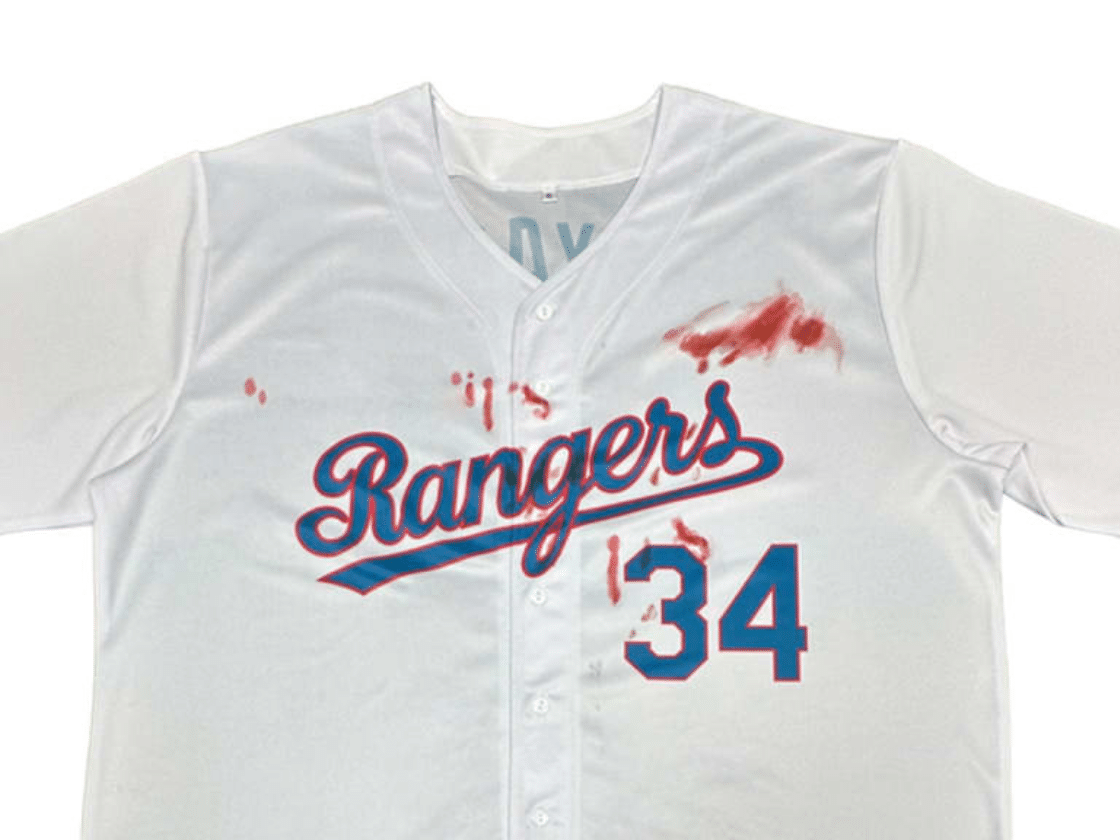
When Texas faced Kansas City, every ticketed fan received a replica blood-stained throwback jersey commemorating Ryan’s legendary game. Unlike many stadium promotions, which are often limited to the first 10,000 attendees, this one was available to everyone with a ticket.
That detail mattered. This was not just another stadium promotion. It was a shared participation moment built around a story fans already knew.
Why does sports merch build fan identity?
Sports merch builds fan identity when it gives fans a visible way to participate in a shared story. The Rangers’ replica Nolan Ryan jersey worked because it connected a memorable franchise moment to something fans could wear, keep and talk about.
Why This Merch Moment Worked
The strongest branded merchandise does not start with the item. It starts with the audience.
For Rangers fans, the jersey connected to a specific memory, a specific player, a specific opponent and a specific kind of identity. It was not generic apparel. It was a physical reminder of a moment that already carried emotional weight.
“When that actually happened, all I could think was, ‘I hope he can stay in,’” Chuck Morgan, the Rangers’ executive vice president of ballpark entertainment, promotions and production, told MLB.com. “It’s so legendary that here’s a guy that’s this tough Texan and he goes out there and gets hit in the face and continues to pitch.”
That is the strategic lesson for marketers: Merch becomes more valuable when it gives people a way to participate in something they already care about.
The jersey worked because it was tied to memory, identity and belonging. Fans were not just receiving a jersey. They were receiving a symbol of franchise history.
The Role Of Authenticity
For a concept like this to work, the details had to matter.
The Rangers’ promotions team did not simply print a red mark on a throwback jersey and call it finished. According to Zach Geist, the Rangers’ director of promotions and ballpark entertainment, the team spent months working through design questions, including how to recreate the blood stain in a way that felt true to the original moment.
“There were discussions from several departments on this, and we kind of talked about if this is even a possible item,” Geist told MLB.com. “Like, can you make a jersey? And then it turned into, well, we could probably screenprint it. We’ve got images, and we’ve got photos. Let’s see if we can recreate it.”
Geist said the jersey went through four or five more rounds of editing than a normal shirt giveaway, with the team testing different color options and printing approaches.
“Trying to find the right blood color and the right printing options to make it look authentic was very tough,” Geist said. “I think it was pretty much like how the jersey looked back then.”
That production detail was more than trivia. It showed why quality is not just a premium add-on. In this case, accuracy was what made the item credible. If the jersey had looked careless, the promotion could have felt gimmicky. Because the team treated the details seriously, the object had a better chance of feeling like a keepsake instead of a stunt.
A Demand Signal, Not A Full ROI Story
The promotion also appeared to create demand. According to the original report, the cheapest tickets for the May 29 game were listed at $63, while other games against the Royals started at $24.
That did not prove the jersey caused the price difference. Ticket prices can move for many reasons, including opponent, date, inventory, timing and demand patterns. But it was a useful signal: When branded merchandise is connected to a moment fans value, it can increase the perceived value of attending.
For marketers, that is an important distinction. The jersey was not just a souvenir of the game-day experience. It gave fans another reason to choose that game, remember that moment and carry the experience forward.
What Marketers Can Learn from the Rangers
The Nolan Ryan jersey showed how branded merchandise can extend the life of an experience when it is planned around audience meaning.
The item worked because it answered several strategic questions:
What memory did it extend?
The jersey brought a famous franchise moment back into the present.
Why did the audience care?
Rangers fans already understood the story and the mythology around Ryan’s toughness.
Why was this the right object?
A jersey was directly connected to the original visual: Ryan on the mound, blood on the uniform, still competing.
What made it worth keeping?
It was specific, recognizable and tied to team identity.
What proof should marketers capture?
Attendance, ticket demand, social sharing, fan sentiment, earned media, resale behavior and post-event use would all help show how the merchandise performed beyond the handoff.
The Bobblehead Follow-Up
The Rangers also planned another Nolan Ryan giveaway for July 20: a “punching” bobblehead commemorating Ryan’s 1993 brawl with Robin Ventura.
That item was sponsored by Nolan Ryan Beef, a fittingly Texas-specific pairing that reinforced how strongly Ryan’s image is tied to local identity and franchise culture.
The bobblehead gave the Rangers another chance to turn a remembered sports moment into a fan participation object. But the same strategic rule applied: the value was not in the novelty alone. It was in the connection between the object, the audience and the story fans already carried with them.
The Planning Principle
Branded merchandise is strongest when it is not treated as an add-on to an event, but as a way to make the event more memorable, participatory and lasting.
The Rangers’ blood-stained Nolan Ryan jersey worked because it did more than commemorate a game. It gave fans a tangible way to revisit a shared memory.
For marketers, that is the bigger lesson: When merchandise is relevant to the audience, authentic to the moment and well-executed in the details, it can become more than something people receive.
It can become something they remember.